
On-chain Data Academy (Part Seven): A Brand New, Ark-involved $BTC Magical Pricing Methodology (II)


Original Article Title: "On-Chain Data Classroom (VII): A Brand New Set, Ark Participated Research on the Magical Pricing Methodology of $BTC (II)"
Original Article Author: Mr. Berg, On-Chain Data Analyst
If you are not familiar with Cointime Price yet, it is recommended to read the first article: "On-Chain Data Classroom (VI): A Brand New Set, Ark Participated Research on BTC's Magical Pricing Methodology (I)"
TLDR
- The Cointime Price series consists of three articles, this being the second article
- This article will introduce the application method of Cointime Price in top avoidance
- This article will introduce a personally designed deviation model
1. Brief Review of Cointime Price
The concept of Cointime Price originates from Cointime Economics, which evaluates BTC's fair price in a "time-weighted" manner.
Compared to simply Long-Term Holders (LTH) and Short-Term Holders (STH), Cointime Price is more elastic, sensitive, and can effectively exclude the influence of ancient lost BTC.
The first article detailed Cointime Price and its buy-the-dip application. If you already understand the concept, let's officially delve into today's topic: top avoidance application
2. Top Avoidance Application Methodology: Cointime Price Deviation Model Design
Cointime Price Deviation is one of the models I designed during my on-chain data research and has been applied in the weekly top avoidance analysis report.
Related Tweet: [Top Avoidance Model Introduction](https://x.com/market_beggar/status/1870763628645032213)
The following text will explain the model's design principles and how to use the model to assess BTC tops. All content in this article is original research, the research process is not easy, so please show your support
1. Quantifying Current Price Deviation from Cointime Price
Why Measure Deviation?
- The Cointime Price highly represents the true holding cost of BTC chips, especially for Long-Term Holders (LTH).
- Since Long-Term Holders have a greater impact on the Cointime Price, when the BTC current price is significantly higher than the Cointime Price, the profit-taking motivation of Long-Term Holders increases, which may trigger distribution behavior.
· Calculation Formula: Deviation Rate = (Current Price - Cointime Price) / Current Price
· Observing Deviation Rate (Distribution Rate)
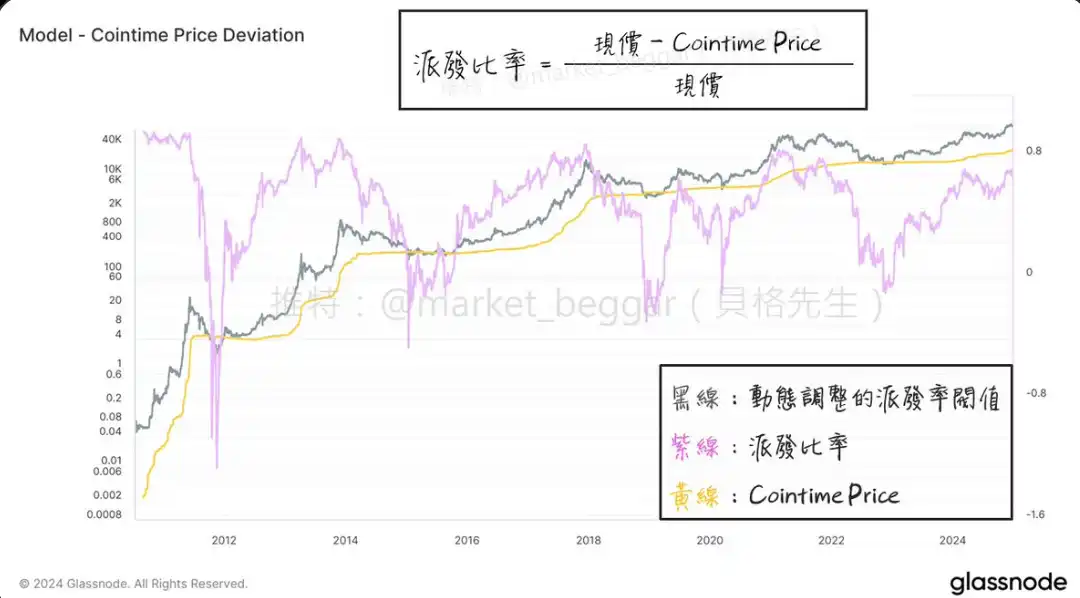
As shown in the chart, we can obtain the Distribution Rate curve (purple line). We can see that: whenever the Distribution Rate is at a high level, it often corresponds to the BTC top.
So, how do we define a "high level"? Next, we will use statistical methods to address this issue.
2. Cointime Price Deviation Extreme Value Definition
If we observe historical data, we will find that the high points of Deviation are not fixed; in each bull market cycle, the peak value of Deviation slightly decreases. Therefore, it is not rigorous to solely use a fixed numerical value to define a "high level."
To address this, I adopt the concept of statistical "standard deviation":
· Calculate the mean and standard deviation of historical Deviation data.
· Define "Mean + n standard deviations" as the "high level (top signal)," referred to as the Threshold.
· Smooth the Deviation data with a moving average to reduce noise.
· When the moving average value of Deviation> Threshold, trigger a top signal.
· Why Use Standard Deviation?
· The historical trend of Deviation exhibits mean reversion characteristics (as shown in the chart).
· Standard deviation measures volatility, so when BTC price volatility decreases, the Threshold will also dynamically adjust, providing more elasticity.
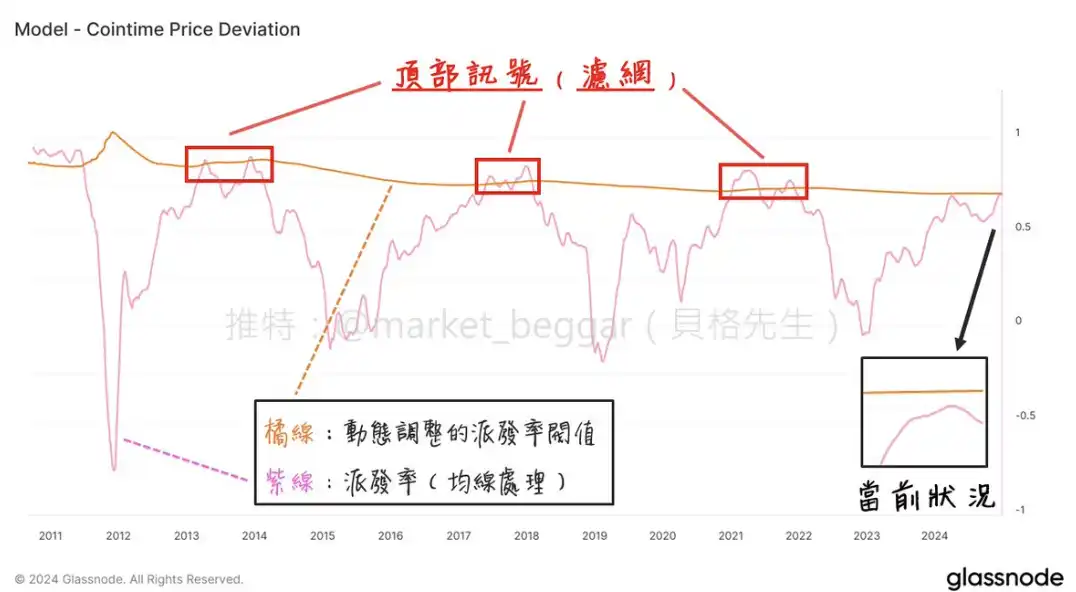
As shown in the above diagram, after the above processing, we can get such a diagram.
· Supplementary Explanation
- In point 2, "Mean + n Standard Deviations," n is an adjustable parameter: the larger n is, the lower the probability of vertex signal occurrence, and the model is more stringent.
- Point 3's moving average smoothing: mainly filters out short-term market fluctuations to improve signal reliability.
3. Top Escaping Signal Example
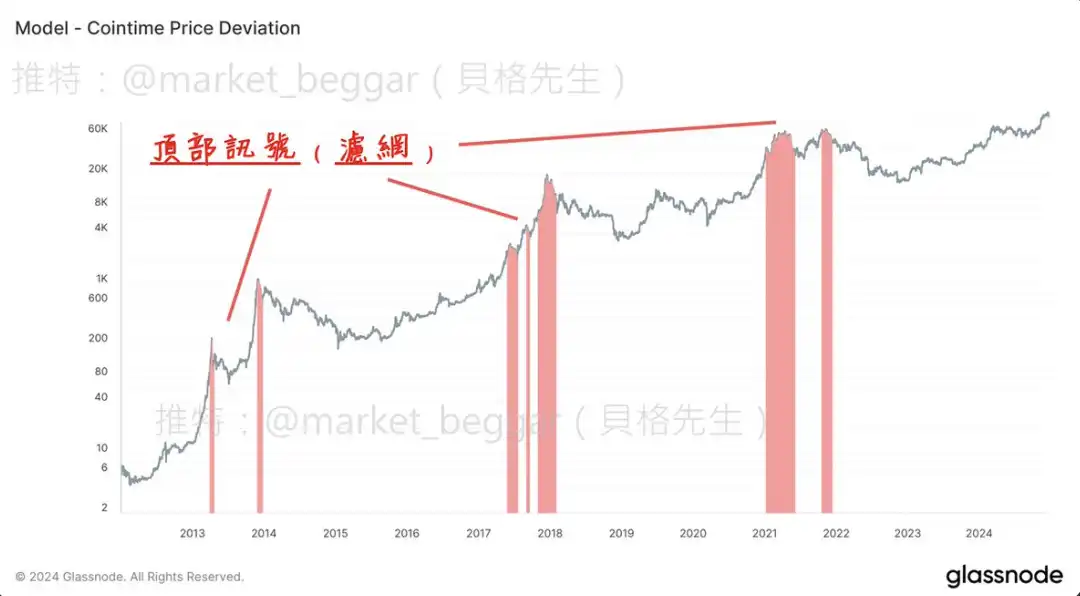
As shown in the figure, when the purple line (Distribution Ratio) exceeds the orange line (Threshold), the corresponding BTC price is often at a phase top.
III. Conclusion
This article is the second in the Cointime Price series, continuing the concepts of the previous article, sharing how individuals can design a top escaping model using Cointime Price.
· Summarize Core Points:
- Cointime Price Deviation quantifies the deviation of the current BTC price from the Cointime Price, speculating on the distribution motivation of long-term holders, used to determine the BTC top.
- The "Standard Deviation" method is used to dynamically define top signals to ensure the model is more adaptive.
- The model has been practically applied in weekly reports and can effectively capture BTC high-level signals.
Future Plans:
- The third article in this series will continue to explore the application of Cointime Price in escaping the top, so stay tuned.
You may also like

How xBubble Breaks the Deadlock in VC's Heavy Investment in the OPC Economy

Dragonfly partner Haseeb: The fastest-growing companies in the future may all be stuck at 149 people

Morning Report | Former Ethereum Foundation researcher establishes Ethlabs; EU Parliament Economic Committee passes digital euro regulatory proposal

Interview with NDV Founder Jason Huang: Popping the AI Bubble and the Myth of Microstrategy, Seeking the Ultimate Ace in the Crypto Market

Morning Report | The South Korean Financial Services Commission plans to expand the regulatory sandbox to include virtual assets; the parent company of the New York Stock Exchange, ICE, has reached a partnership with OKX to jointly establish a cryptocu...

Exclusive Interview with Strategy CEO: Putting Aside the Sale of 32 BTC, the 60 Trillion AI Intelligence is the Ultimate Fate of Bitcoin

TRON revitalizes the image of the bull, creating a more approachable brand character
Will the STRC issuance price discussed with ChatGPT really fall into a death spiral?

The foundation retreats, Ethlabs steps forward: Ethereum welcomes its largest restructuring in history

NYSE Parent ICE and OKX Launch Joint Venture: What It Means for Tokenized Stocks
ICE and OKX have announced a joint venture focused on tokenized stocks, but stock futures are already live across crypto markets. Here's what the partnership means, how stock futures work, and why traders are paying attention.

How to Trade Apple and Nvidia on a Crypto Exchange in 2026 (Without Buying Shares)
Morning Report | Secret Network loses $4.67 million due to cross-chain vulnerability; Michael Saylor releases Bitcoin Tracker information again, may disclose increased holdings data next week
Kalshi's biggest competitor is not Polymarket

The second half of the computing power battle: Intel CEO Pat Gelsinger reveals how AI is reshaping the global semiconductor supply chain
B.AI partners with MiniMax to launch a limited-time free experience of M3, enabling zero-threshold implementation of Agentic productivity through full-stack infrastructure

A company that was on the verge of bankruptcy has just surpassed Bitcoin in market value

The two giants are racing in "credit": loan balances of 9.9 billion vs 14.6 billion USD, Brazil has become the main battlefield
Rented Belief: How Much of the Bitcoin ETF Fund Flow is Real Money
How xBubble Breaks the Deadlock in VC's Heavy Investment in the OPC Economy
Dragonfly partner Haseeb: The fastest-growing companies in the future may all be stuck at 149 people
Morning Report | Former Ethereum Foundation researcher establishes Ethlabs; EU Parliament Economic Committee passes digital euro regulatory proposal
Interview with NDV Founder Jason Huang: Popping the AI Bubble and the Myth of Microstrategy, Seeking the Ultimate Ace in the Crypto Market
Morning Report | The South Korean Financial Services Commission plans to expand the regulatory sandbox to include virtual assets; the parent company of the New York Stock Exchange, ICE, has reached a partnership with OKX to jointly establish a cryptocu...
Exclusive Interview with Strategy CEO: Putting Aside the Sale of 32 BTC, the 60 Trillion AI Intelligence is the Ultimate Fate of Bitcoin


