
「Zero Fee」 Illusion: Lighter Nodes Shifted Costs with High Latency

Original Article Title: Lighter's "0% Fees" Are Actually 5-10x More Expensive Than Other Exchanges
Original Article Author: @PerpetualCow, Crypto Influencer
Original Article Translation: AididiaoJP, Foresight News
There's a saying in the market: If a product is free, then you are the product.
Lighter DEX is currently promoting "zero fees" to retail traders. It sounds too good to be true, and indeed it is.
However, what Lighter didn't prominently display is the toll structure behind these "free" trades.
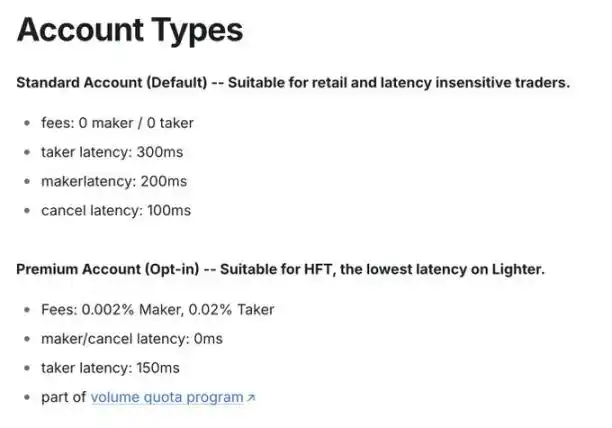
Lighter offers two account types: once you understand how the toll structure works, you'll realize that the 0% fee is actually the most expensive tier on the platform.
That 200-300 millisecond delay is the crux of their business model.
What Does 300 Milliseconds Really Mean?
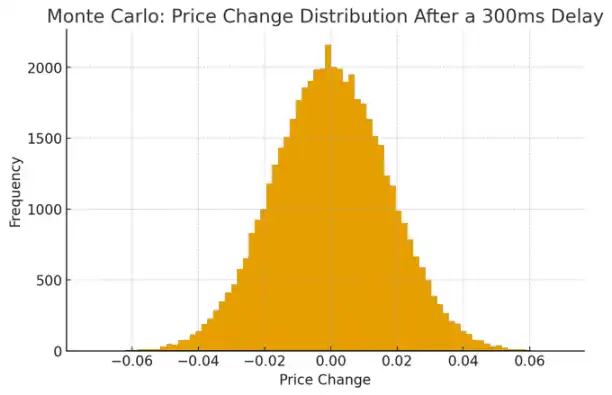
An average human blink takes about 100-150 milliseconds. By the time you blink twice, faster traders have already captured price movements, adjusted positions, and engaged in a trade against you.
The crypto market is highly volatile, with typical volatility levels (50-80% annualized), causing prices to move about 0.5 to 1 basis point per second.
This means that within 300 milliseconds, market noise alone can cause prices to move on average 0.15-0.30 basis points.
The True Cost of "Free"
If we quantify it:
Academic research on adverse selection costs (Glosten & Milgrom, Kyle's Lambda, etc.) indicates that the informational advantage of informed traders is usually 2-5 times the magnitude of price random walk.
If the random slippage within 300 milliseconds is about 0.2 basis points, then adverse selection would add an additional 0.4-1.0 basis points.
For active traders and liquidity providers, the actual costs are roughly as follows:
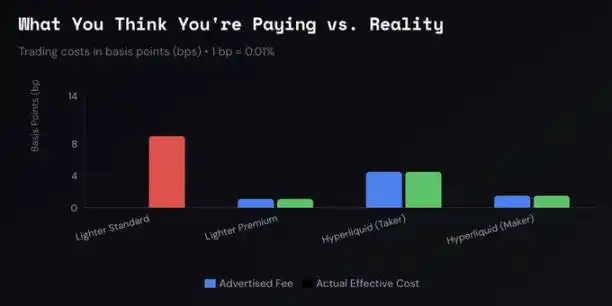
· Standard Account Actual Cost: 6–12 basis points (0.06%–0.12%) per transaction
· Advanced Account Actual Cost: 0.2–2 basis points (0.002%–0.02%) per transaction
The cost of a "free" account is 5–10 times higher than that of a paid account.
Zero transaction fee is just a marketing number; the real cost is hidden in the latency.
The advanced account is actually more cost-effective, without a doubt
In any case, the standard account (0% fee) is not the preferable choice.
It is not suitable for small retail investors, large holders, scalpers, day traders, or even passive investors. Especially not for liquidity providers, or anyone, for that matter.
"I am just a small retail investor; I don't need an advanced infrastructure."
Wrong.
Small retail investors are more vulnerable to slippage. If you trade with $1,000 and lose 10 basis points per trade, it is like losing $1 each time. After 50 trades, 5% of your account will silently disappear.
"I don't trade frequently; latency doesn't affect me."
Also wrong.
If you don't trade frequently, the cost of an advanced account is negligible anyway.
Yet even in a few trades, the execution price you receive is still worse. Since the cost of avoiding such losses is almost zero, why accept any disadvantage?
Directly upgrade to an advanced account.
This model has a precedent
The traditional financial markets have long witnessed this tactic, known as payment for order flow.
@RobinhoodApp once attracted retail investors with "commission-free trading," then routed orders to liquidity providers, allowing them to profit by trading against the uninformed orders of retail investors, thus popularizing this model.
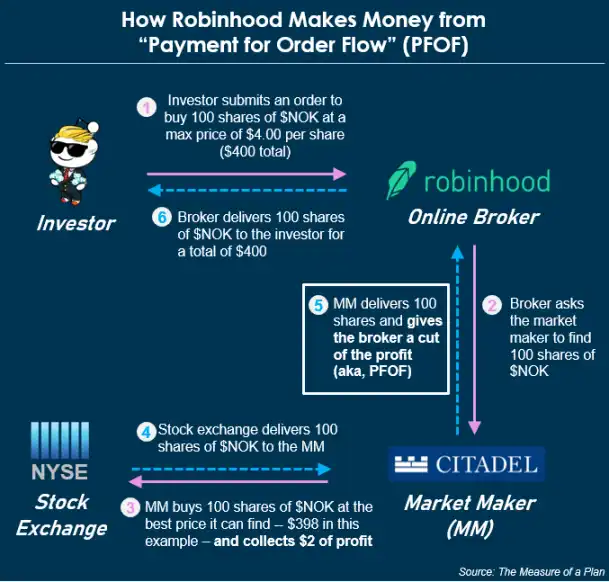
Lighter's model is structurally similar to this. Standard accounts do not receive free trades; they receive slower trades. This latency is transformed into profit by faster participants.
The trading platform does not need to charge you a fee because you are actually paying with execution quality.
What Lighter Did Right and Wrong
Lighter did not conceal latency data, as it was clearly stated in the documentation.
However, transparency does not equal clarity.
By highlighting "0% Fee" in the headline but burying "300ms Latency" in the fine print, Lighter employed a strategy focused on registration conversion rates rather than user understanding.
Most retail traders do not understand the implications of latency, are unaware of adverse selection, and naturally cannot calculate the equivalent actual cost.
Lighter is clear about this.
Advanced accounts are more cost-effective in every way compared to the standard "zero-fee" account—there is no debate about this.
You may also like

When reasoning becomes a scarce resource, who captures its value?

Jensen Huang dramatically "rescues" the South Korean stock market
Stablecoins vs Deposit Tokens: On the surface, they seem like opposing sides, but in reality, they are interconnected

Bitcoin Crash to $50,000 or Bear Trap Before $100,000? Deep Dive for WEEX Traders

Yang Ge Gary: Agent Economics and AI Microeconomics

Founder of Baixing.com: My Experience with Claude Code in Fourteen Points

How Could the SpaceX IPO Affect Bitcoin, Altcoins season, and Crypto Liquidity?

RootData: May 2026 Cryptocurrency Exchange Transparency Research Report

Should we escape the peak? The principle of the tail-end market in the stock market

Morning News | Five major virtual asset platforms in South Korea have experienced 57 incidents of hacking and system failures in six years; Grayscale submits registration application for Canton ETF

The ambitions of Kalshi, MTS, and a16z

The AI bubble is bursting

Real withdrawal is to release water: When crypto VCs position themselves in the Agent network effect

Has the narrative of BTC as "digital gold" failed?
A Perspective on the Indian Cryptocurrency Market: Descending into Silence or Moving Towards Maturity?

It took me a year to see the painful truth about Agent payments

Morning News | Bitmine issues preferred shares to raise $300 million; Polymarket accuses Kalshi of industrial espionage
Privacy coin trust crisis! ZEC plummets over 56% in a single day
When reasoning becomes a scarce resource, who captures its value?
Jensen Huang dramatically "rescues" the South Korean stock market
Stablecoins vs Deposit Tokens: On the surface, they seem like opposing sides, but in reality, they are interconnected
Bitcoin Crash to $50,000 or Bear Trap Before $100,000? Deep Dive for WEEX Traders
Yang Ge Gary: Agent Economics and AI Microeconomics
Founder of Baixing.com: My Experience with Claude Code in Fourteen Points


